Artificial Intelligence (AI) has moved beyond a simple conversational tool. If 2023 was the year of the Large Language Model (LLM) like ChatGPT, 2025 is rapidly becoming the year of the AI Agent.
This shift marks a fundamental change in how we interact with technology: from asking a tool to perform a single step (like writing an email), to delegating an entire multi-step task (like planning a trip or managing a complex project). This is the key trending topic dominating tech news, enterprise strategy, and the future of work.
What Exactly is an AI Agent?
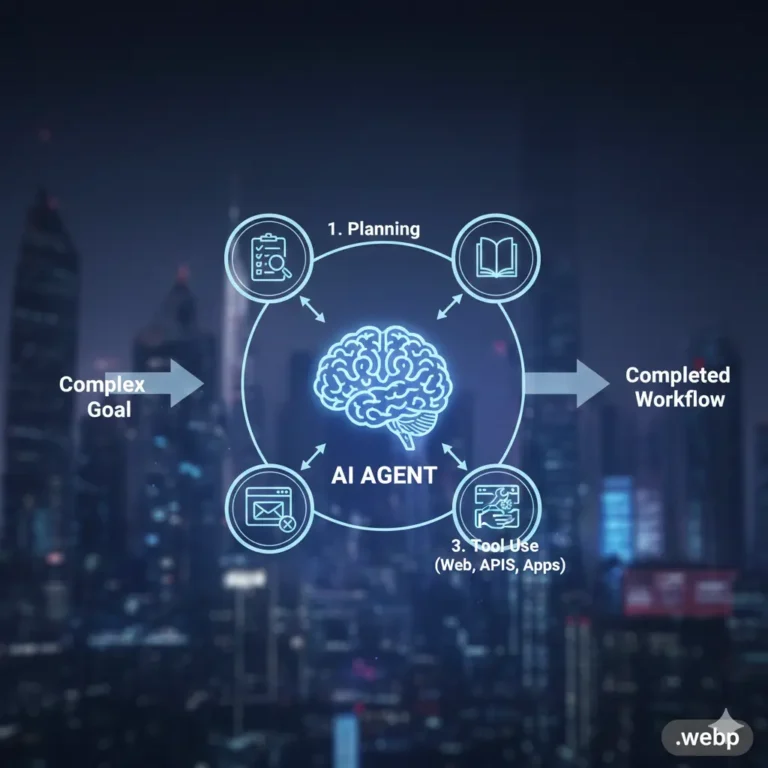
An AI Agent is a sophisticated system built on top of foundation models (LLMs) that possesses four critical characteristics:
Planning: It can break down a complex, high-level goal into a series of smaller, manageable steps.
Memory: It can retain information from previous actions and interactions within a session, learning and adapting as it works.
Tool Use: It can access, select, and utilize external tools, APIs, and software (like searching the web, booking a calendar event, or editing a document) to complete its tasks.
Autonomy/Reasoning: It can execute the plan, self-correct if a step fails, and reason its way through obstacles until the final goal is met.
In short: An agent isn’t just an answer engine; it’s a digital employee.
Key Areas Where AI Agents are Transforming Work
The most immediate impact of AI Agents is being felt across industries:
IT & Knowledge Management: Agents are already being used for service-desk management, automatically diagnosing and resolving common IT issues, and performing deep research across massive knowledge bases.
Customer Service: Next-generation customer bots will not just answer FAQs but will be able to perform actions like processing returns, modifying subscriptions, and troubleshooting technical problems autonomously.
Marketing & Sales: Agents can research competitors, generate full campaigns (including copy and visuals), and even qualify sales leads by autonomously searching for company data and sending personalized initial outreach emails.
Software Development: Agents are becoming “pair programmers,” capable of fixing bugs, writing entire code blocks based on a natural language prompt, and automatically running tests.
The Challenge: Governance and Trust
The rapid deployment of autonomous systems raises critical questions that businesses must address:
Auditability: How do we track an Agent’s decisions to ensure compliance and explainability?
Security: If an Agent has access to multiple internal systems and tools, how is that access managed and secured?
Bias and Ethics: If an Agent learns from its own failures, how do we prevent it from developing biased or undesirable behaviors over time?
The key to successful agent adoption is not just in the technology, but in building robust governance and control systems around it.
Conclusion: Your Digital Teammate is Clocking In
The transition from single-task AI to multi-step AI Agents represents a pivotal moment. It signifies AI’s evolution from a niche utility to a true partner in business and personal productivity.
The companies and professionals who quickly learn to harness the power of these autonomous workflows—by defining clear goals, providing the right tools, and overseeing their actions—will be the ones who lead the next wave of efficiency and innovation.